

Wednesday, March 27, 2013
Honored to be included

Tuesday, March 19, 2013
Thinking about Amy

There’s no question that my sister was the best of
my family. Beautiful, smart, generous and selflessly driven to help others, Amy
also ended up with mom’s boundless energy. Myself, I inherited a little bit of
my mom’s drive , but I mostly tend towards my dad’s more slothful nature. Since
my brother is now a lawyer, I’ll just say he’s also more like my dad. But my
sister was something completely different.
During the first Gulf War, Amy was a captain in the
army and was one of the first US soldiers in Iraq where she was responsible for
setting up the army’s medical labs. There was an accident where a jeep
overturned in a minefield, and Amy risked her life to save the people involved.
She was a recipient of the Douglas MacArthur Leadership Award, and when she
returned from Iraq, the army sent her to work on her Master’s Degree in Medical
Lab Technologies. While she was fulltime at school, she joined the Big Sister
program, was helping out local hospitals in improving their medical labs, as
well as being involved in several environmental charities.
My sister’s one failing was during a bad point when
she was a teenager and suffering low self-esteem, she let this utterly
worthless piece of shit (who I’ll refer to in the rest of this simply as UWPOS)
get himself entrenched in her life, and later she let UWPOS convince her to
marry him. UWPOS was a low-level con who peddled drugs and was involved in
other lowlife behavior, which he unfortunately was able to hide from my sister.
When Amy went to Iraq, UPWOS got more emboldened in his activities. Before the
war, Amy was stationed in San Antonio, and my parents moved there to be with
her. One day after Amy had left to Iraq, UWPOS invited my parents for a day
trip, during the course of which my sister’s brand new jeep (which she bought
right before the war and was the first new car she ever owned) was stolen. It
turns out UWPOS had arranged the jeep to be stolen, and used my parents as unwitting
alibis. The police caught him, though, when he was chopping the jeep for parts,
but instead of notifying my sister, they made him a snitch, and my sister never
found out about it.
Twenty years ago Amy was supposed to come up and
stay with me the day before Mother’s day so that we could all take my mom out.
She didn’t come, and she didn’t answer her phone. While Amy was in school in
New England, UWPOS was supposed to be finishing up his college degree in San
Antonio—at least that’s what he convinced my sister. In fact, Amy was planning
to buy him a sailboat as a graduation present. Of course, he was never in
college—it was just a con he had sold my sister—and he was instead simply doing
his lowlife criminal shit. But as I mentioned before, he had gotten emboldened.
Several weeks before Mother’s Day he was trolling other lowlifes at bars in San
Antonio, trying to find someone to help him murder my sister. He found one. The
Friday before Mother’s Day 1993 he drove up from Texas with his POS accomplice
and murdered Amy. Two women sharing an apartment above where Amy was living
heard my sister screaming for help for over five minutes but didn’t bother
calling the police. They never gave the police or DA a reason why they didn’t
do this. Supposedly UWPOS killed Amy for her life insurance, and while that was
part of it, I’m sure he did it more because it was killing him how well Amy was
doing in life while he was nothing but a miserable lowlife UWPOS.
Twenty years later it’s still maddening when I think
of all the ways Amy could still be alive if someone had acted with just a tiny
bit of human decency. If the San Antonio police had notified Amy about UWPOS
stealing her jeep. If those neighbors had called the police. If one of those
lowlifes UWPOS approached to help him had called the police. But none of that
happened.
Bad Thoughts was the first thing I wrote after Amy’s
death, and I started the first draft in 1996. It was too bleak and grim and
violent a book to dedicate to my sister’s memory, but it was the most personal book I wrote. All my rage and anguish over Amy went into the book. Astral
projection plays a key role in it, and after Amy’s death I read several books
and took classes in the subject. I badly wanted to learn how to do it, if it
was at all possible, for the obvious reason. The techniques that the books and
classes gave were basically waking yourself up after a few hours of sleep (when
you’d be most susceptible to having an OBE—Out of Body Experience), and then
giving yourself the suggestion that you’re going to leave your body safely. I
had several experiences where I was obviously dreaming that I was leaving my
body. It had that unreal dreamlike quality to it. But then I had one experience
that was very different. In this one I felt that ripping-out-of-my-body
sensation that the books and classes talked about, and then it was as if I was
hanging over my bed in this hyper-sense of reality with nothing at all
dream-like about it. As I hung over the bed I was afraid I was going to fall to
the floor and wake up my wife, and all at once it was as if I was sucked back
into my body. Was this a real OBE or did I self-hypnotize myself to believe I
was having one? Hell if I know. I quit trying soon after that. It was doing a
number on my sleeping, and I was working at the time as a software engineer,
and I couldn’t go to work exhausted every day. I figured if the books were
right, I’d have my chance to see Amy again later.
It took ten years before I could talk about Amy to my closest friends. The thought of ever writing something like even a couple of years ago wouldn’t have seemed possible. But she’s been on my mind so much lately, and I’ve had this compulsion to write this. I’m not exactly sure why. Maybe it’s because the twenty year anniversary of Amy’s death is approaching. Maybe it’s because with both my parents now gone, there’s no one really left to talk about Amy. Maybe it’s because it’s because I want her to exist, even if it’s only in a blogpost.
Monday, March 11, 2013
Stuttgarter-Zeitung (translated) review of Pariah


On a trip to New York Kyle Nevin gets in a bad mood. Just
so, after eight years of incarceration, he recently goes free again alone
through Central Park at night in the hopes of getting mugged by someone. More
“would be better” as the first person narrator of Pariah says. Yes, this
habitual criminal from South Boston solves not only money problems but also
emotional crises by force.
In “Pariah” a huge rage ferments. Kyle wants to revenge himself upon Red Mahoney, his former boss, who betrayed him to the FBI and then disappeared. The author Dave Zeltserman first gives Kyle a tunnel vision, an energy, an unfrayed speech that reminds us of the classics of hardboiled literature. But he refrains from using Kyle’s hardness as a massive shell for a good core, as we are used to in some hardboiled heroes. The egomaniac Kyle, among whose fondest youthful memories consist of beatings of innocent passersby pokes evil fun at himself over this stereotype.
The only rule of courtesy: shut up
Zeltserman is so refined as to very gradually pull the
carpet out from under us readers’ feet. Kyle complains initially about the
moral decay in South Boston, over the loss of backbone and decency inflicted by
Mahoney. Based on these tirades the reader might liken the narrator to a Tarzan
of the slums and thus begin to like him as someone who within his brutal world
still possesses some values and like all of us suffers from the shrinkage of
values. But as to honor among thieves Kyle only understands shutting up when it
comes to the dealing with the police.
He is in the worst way egotistical and bullying his raw
charm only a means to an end, and whatever love for his brother he evinces only
lasts as long as his acts as Kyle wishes. “Pariah” is a monstrous book of
self-righteousness in which Kyle propounds the grossest atrocities as the only
possible means of behaving.
Blood sells itself finely
But Zeltserman does not dismantle him easily, in a beautiful
sleight [or twist (of plot)] he lets the blood tainted fall into the clutches
of the publishing business which best knows how to market the creepiness of
such types.
When the miserable underworld of South Boston and the
lacquered publishing world of New York meet, then Zeltserman doesn’t only
ridicule the media and cultural norms. He often puts in question exactly that
which he himself bravely peddles, namely the conversion of criminality and horror
into thrillers. Whoever reads “Pariah” cannot simply browse away in fascination
but must answer his own questions as to why he actually does.
Saturday, March 2, 2013
Introducing THE SHANNON NOVELS
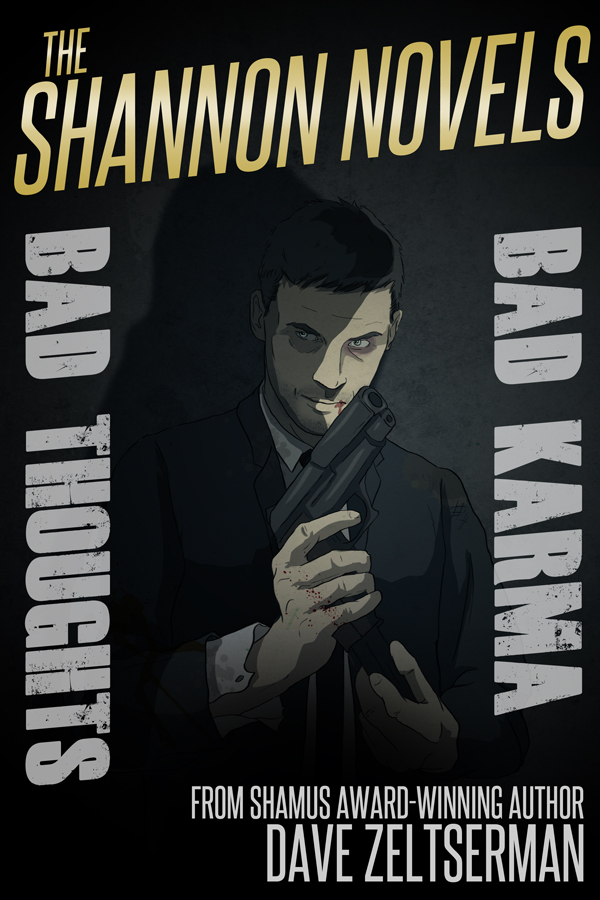
Bad Thoughts was the second novel I wrote (FAST LANE being the first), and it's my grimmest and bleakest book, as well as maybe my most gripping and intense. The book takes place in the Boston area and, in keeping with the grim outlook of the book, it takes place during the winter months with the weather throughout being bitterly cold, often with sleeting rain. Shannon is a Cambridge police detective who sees his marriage disintegrating, and well as possibly his sanity. To say that Shannon goes through hell in this book is a massive understatement. Even with all the craziness and horror in Bad Thoughts, at its core it's a book about surviving abuse.
Bad Karma was the fifth book I wrote (between OUTSOURCED and THE CARETAKER OF LORNE FIELD), and it's a very different book than Bad Thoughts--even the genres are different, with Bad Thoughts being a mix of horror and crime and Bad Karma being hardboiled PI. While Bad Thoughts might at its core be about surviving abuse, Bad Karma at its core is about healing yourself and moving on in life.
Bad Karma takes place five years later and has moved the action to Boulder, Colorado, with Shannon now working as a PI. The novel takes place during the summer: the weather's sunny, Shannon has reconciled with his wife, and both of them happier and more in love than ever. But just as the weather changes dramatically three-quarters of the way into the book, so does the brutal violence that rolls in. The last 70 or so pages are probably as gripping as anything I've written. Bad Karma also intersects with Outsourced and Fast Lane. The theme of white collar workers (specifically software engineers) being obsoleted and discarded that was written about in Outsourced is carried on in Bad Karma. Shannon also meets up on the hard streets of Denver with one of the central characters from Fast Lane.
What drove the plot of Bad Karma were two ideas--one, an idea that I tried to write as a short story but just could never get to work right in that form, the other, some people I knew signed up for what they thought were yoga classes at a suburban shopping area with an organization that major news outlets have called a cult in their reports.
As different as both of these books are, they fit well together, both thematically, and because of what Shannon went through in Bad Thoughts you want to see this happier version of his life. And as different as these books are, they're not only connected by Shannon but certain metaphysical elements. With Bad Thoughts, astral projection plays a significant role, and while the metaphysical aspects are more subdued in Bad Karma, they're still there.
Here's what some people said about these books when they were originally published:
"Dark, brutal, captivating -- this is one hell of a book, the kind of book that doesn't let go of you once you start it. Dave Zeltserman is clearly the real deal." Steve Hamilton, Edgar Award-winning author of THE LOCK ARTIST
"This fast-paced, gritty psychological tale balances the fine line between mystery and horror" Library Journal
"Bad Thoughts is an ambitious genre-bender combining the paranoia and existential dread of the best noir with a liberal dash of The Twilight Zone. Not to be missed." Poisoned Pen Booknews
"Detective Bill Shannon is back and a welcome return it is." Booklist, Elliot Swanson
"top-notch P.I. reading" Bookgasm
Wednesday, February 27, 2013
A slice from FAST LANE

Fast Lane was not only my first novel, but the first piece of fiction I ever wrote with the intention of seeing it published. I originally wrote it in 1990, revised it in '92, self-published it as In His Shadow in '01, sold it to the Italian publisher, Meridiano Zero in '02, and then to Point Blank Press as Fast Lane in '03.
“I’ve been so worried about
Debra.” He handed me the drink and sat across from me. “I haven’t been able to
work,” he said. “I can’t believe how quickly you found her.”
I took a long sip of the scotch
and leaned back in my chair.
“To be honest,” he went on, his
smile beginning to show some strain. “You’re making me nervous with the way
you’re acting. How bad is it with Debra?”
“Why don’t you pay me the
three-thousand-dollar bonus you promised? Then I’ll tell you all about it.”
He sat for a moment, blinking a
few times. “I thought I’d pay you once you’d brought her home,” he said.
“I think it would be better if we
did it this way.”
“I-I guess it doesn’t matter.
You’ll bring her home later today?”
“That’s right.”
“And I could always stop payment
on the check if you don’t.”
“Of course you could.”
He pushed himself up. “Why don’t I
go write the check?” While I waited for him I finished the rest of my scotch.
When he came back, I noticed some
moisture had formed over his upper lip. He handed me a check for three thousand
dollars. I put it in my wallet and told him where I had found Debra and what
she had been doing.
As I talked he kept muttering
about his poor little girl, but for a second, I guess before he had any control
over it, a look of excitement flushed over his face. He must’ve realized,
because he quickly buried his face in his hands. When he pulled them away he
was the picture of the tortured dad. He had even squeezed out a couple of
tears.
“Oh dear God,” he cried softly. “My poor little girl. Thank you so much for finding
her.”
I stood up and turned away, but I
couldn’t get that picture of him out of my mind, of him getting excited hearing
what his daughter was doing for a buck in a peep show.
“Oh God,” he was going on, hamming
it up. “I’ll make sure she gets professional help. I’ll make sure—”
I spun on my heels and swung at
him, catching him hard on his mouth and bursting his lip wide open. He went
down like he’d been shot. I only half saw him as he curled into a fetal
position, spitting out blood and a couple of teeth.
He lay on the ground blubbering. I
stood over him, trembling, trying not to look at him, trying not to think about
him, trying not to do what I wanted to do. I went to the bar and poured myself
another drink. I downed it quickly and refilled the glass.
Tears streamed down his face and
mixed with blood. Between sobs, he murmured that I was insane and that he was
going to call the police. I walked over to him.
“Your daughter told me.”
“You’re crazy!” Thick red bubbles
popped from his mouth. “Get out of here! Get out of here now!”
I kicked him in the stomach and
that started him blubbering even harder. I leaned over and grabbed him by his
hair and pulled him up so he had to look at me.
“She told me all about you,” I
said. “About you raping her and—”
“You going to believe that lying
bitch? That lying little cu—”
I threw him down and kicked him
hard in the chest, giving it just about everything I had. I kicked him again.
Both times I heard his ribs crack. He moaned and curled up tighter. I was still
holding the glass of scotch, although I’d spilled half of it when I was kicking
him. I drank what was left. “She’s not lying.” I repeated everything his
daughter had told me. When I’d finished I said, “When I bring Debra here later
you’re going to be long gone. For good. God help you if she ever sees you
again.”
“What am I going to tell my wife?”
he asked softly, and then broke out with more blubbering.
“That’s your problem.” I turned
away. I had to. I walked over to a rosewood bookcase and picked up a family
portrait. In it, Craig Singer was smiling with all his teeth intact, arms
wrapped around his wife and daughter. If you glanced at it you’d think it was
just as it appeared, a typical upper middle-class family picture. The proud
father, the loving but impatient wife, the sullen bored teenager. But if you
looked a little more carefully, you’d realize it wasn’t boredom on Debra
Singer’s face, any more than it was teenage angst. And if you looked hard
enough, you could detect rigid lines around Mrs.
Singer’s eyes and mouth that might indicate something more than impatience.
Singer whimpered. I put the photo
back on the bookcase. “I’m hurt pretty bad,” he moaned. “I need a doctor.”
“Again, that’s your problem.”
He pushed himself up into a
sitting position. I knew he was in a good deal of pain. He’d have to be with a
busted up mouth and a chest full of cracked ribs.
“You don’t understand,” he said.
“I love my daughter. She’s all I care about. If you give me a chance I can
change and—”
“You better stop now while you
can. In another minute it’ll be too late.”
He started crying again. “What am
I going to do?”
“You’re going to get out of here,”
I said. “Now. I don’t know how much longer I can stomach being around you.”
He slowly got to feet, moaning
every inch of the way. He grabbed his side loosely and headed towards the
staircase. He said he was going to pack a few things. I told him there wasn’t
time. He hesitated and then turned around and hobbled to the bathroom. I
watched as he cleaned and bandaged his mouth. The bandaged area had already
swollen to the size of a small melon. I didn’t see the point in what he was
doing, but I also didn’t see any point arguing with him.
When he was done, he asked again
about packing some items. I shook my head. I followed him as he left the house.
As he got behind the wheel of his
Volvo his expression changed, the submissiveness in his eyes shifting to
something else, something cagey. He waved me over.
“You have no right,” he said.
“What you did was assault and battery. Possibly attempted murder.”
“I guess you could look at it that
way.”
“You guess I could look at it that
way? I could sue you for every penny you got and then put you in jail.”
“Well, you could sure try.”
“I could do a lot more than just
try.” He watched carefully for my reaction. “If you tell anyone about your
allegations or write about them in your newspaper column, you’ll find out how
much I can do.”
“Yeah, well, if you’d like we
could go to the police right now. I’d be glad to bring Debra along and have her
tell her story.”
His jaw muscles tightened as he
looked away. Blood seeped from his bandaged mouth and dripped down his shirt.
“You better keep quiet about this, Lane. If you don’t, I’ll sue you.” He turned
back, facing me. “And I’ll move back home.”
I leaned forward, resting on his
window. “Let me make sure you understand something,” I said as politely as I
could. “The only reason I won’t write about this is because I don’t want to
make things any more difficult than they already are for your daughter. If she
ever sees your face again, I promise you there won’t be any face left afterwards.”
He put the car in gear and stepped
on the gas. I had to jump back to keep from having my feet run over.
Of course, he was only kidding
himself. I guess the finality of it all hadn’t sunk in yet, but it would. It
was only a matter of time.
I looked down and saw my hands
were shaking worse than a junkie’s. I squeezed my eyes shut, trying not to
think about Craig Singer, about what I almost did to him, about what I wanted
more than anything to do to him. Because when I was standing over him I knew I
came within a hair’s breadth of sending him straight to hell. It took every
ounce of strength I had to keep from doing it.
I stood there for a while and then
got in my car and waited until the shaking stopped.
Tuesday, February 26, 2013
Review (translated) of Pariah from the German newspaper Badische Zeitung


One of my best friends since college, Alan Luedeking, who's fluent in at least 3 languages (English, German, Spanish) and close with several others, translated the review of Pariah that ran in the German newspaper, Badische Zeitung. A quick note about Al: we've been buddies since our days in Boulder, Colorado, and Al's been my unofficial editor on almost everything I've written. The reason Al's fluent in German and Spanish is his parents fled Nazi Germany, and even though they're Jewish, they ended up in a detainment camp for German refuges in Texas. When they got out of there, they went to Nicaragua, where starting from nothing built a successful industrial machinery company. When the Sandinistas took over, they then fled to Miami, where they again started from close to nothing and built yet another successful company. Back in Boulder, when I'd be hanging around Al's apartment, and he'd be talking with his parents back in Nicaragua, the conversation would switch rapidly between English, Spanish, and German to confuse anyone from the government who might be listening in.
Here's Al's translation:
Grandiose anti-bestseller "Pariah" reviewed by Joachim Schneider
There are books which will never make it onto the bestseller list, which their authors know full well, particularly if they deliberately avoid the common clichés. Dave Zeltserman has made himself a game out of that, leaving a bestseller that in two weeks sells a million copies that almost went on his account to [instead] eke out a niche place. Too dark and too angry is “Pariah”, too little romantic. It offers too little identification potential to rip out a place for itself in the criminal genre market.
Yet all could have been good, since the beginning constellation has everything that a fat criminal menu needs. Kyle Nevin is released from the slammer after 8 years. Only one goal drives him: revenge on his boss and mentor who delivered him to the knife. A mobster, as he is in the book, big-mouthed and reckless. An Irish macho, who at times bucks out of the traces but in principle a contemporary to whom one can relate—but one must never cross him.
Rough but heartily goes it in South Boston among the Irish, thus the cliché, but Zeltserman, who sets a hellish pace, lets brutal outbursts flow in from the outset, and it soon becomes clear that here no ordinary or even romantic Gangster-Revenge-Piece will be given, rather a provocation. Here frontiers are explored, and the bearable stretched to its uttermost limits. The first-person narrator outs himself as an unscrupulous scumbag who without a flickering an eyelash tramples over corpses.
In order to finance his revenge mission, Nevin plans a child’s kidnapping, hires his brother as accomplice like in old times, not without destroying his new suburban lifestyle in the process—and not only that. The ten-year-old kidnap victim, a hemophiliac, dies, as the gangster rips out one of his teeth. At that, the oh-so-smart Nevin lets an accomplice pull one over on him. The coup goes thoroughly to shit. No, nobody, wishes this character anything good, not even his [female] lawyer who, on the grounds of an FBI deception garners him an acquittal. This acquittal marks the starting shot to a writing career, after the the big-mouth writes an article about the world that the New York Times actually publishes and which attracts the attention of a crafty publisher.
Admittedly, the public knows much less about this monster than the reader (another slick twist of this novel), yet that the media and public switch off understanding and morality when it comes to a publishing sensation, in terms of authenticity—that one buys from Zeltserman immediately. For what reasons Nevin’s writing career falters, surpasses all imagination in cynicism. In the early morning tv shows the bad guy is unmasked, as what we will not betray. Media satire, metacriminality, fierce thriller, all wrapped up in Zeltserman's terrific book that will now lead a shadowy existence because all traces of romanticism have been eradicated. Nevertheless, a trace of black humor flashes through his lunatic wit.
Subscribe to:
Posts (Atom)